"Amen, amen, I say to you, unless a grain of wheat falls to the ground and dies, it remains just a grain of wheat; but if it dies, it produces much fruit. " (John 12)
Photo copyright : John R Portelli

Friday, 12 October 2018

Inheriting Eternal Life

Twenty-eighth Sunday in Ordinary Time

It-28 Ħadd matul is-Sena 
Messalin B p 487

Reading 1
Wisdom 7:7-11
I prayed, and prudence was given me; I pleaded, and the spirit of wisdom came to me.
I preferred her to scepter and throne, and deemed riches nothing in comparison with her,
nor did I liken any priceless gem to her; because all gold, in view of her, is a little sand,
and before her, silver is to be accounted mire. Beyond health and comeliness I loved her,
and I chose to have her rather than the light, because the splendor of her never yields to sleep. Yet all good things together came to me in her company, and countless riches at her hands. This is the Word of the Lord.

L-Ewwel Qari
mill-Ktieb tal-Għerf  7, 7-11
Jien tlabt u qlajt għaqal; Sejjaħt, u ġie  fuqi l-ispirtu tal-għerf. Dan  l-għerf qistu aqwa minn kull xettru u tron, u ntbaħt li l-għana m'hu xejn ħdejh. Ma  xebbaħtx miegħu l-ħaġra l-aktar prezzjuża, għax id-deheb kollu ħdejh mhuwiex ħlief ftit ramel, u l-fidda quddiemu qisha ftit  tajn. Aktar  mis-saħħa u s-sbuħija ħabbejtu, u għoġobni aktar mid-dawl; għax id-dija tiegħu ma tgħib qatt. Mal-għerf ġieni il-ġid kollu, u miegħu ġiebli għana bla qjies. Il-Kelma tal-Mulej

Responsorial Psalm             
pSALM 90:12-13, 14-15, 16-17
R. (14) Fill us with your love, O Lord, and we will sing for joy!

Teach us to number our days aright,
that we may gain wisdom of heart.
Return, O LORD! How long?
Have pity on your servants!                                                    R/
                                  
Fill us at daybreak with your kindness,
that we may shout for joy and gladness all our days.
Make us glad, for the days when you afflicted us,
for the years when we saw evil.                                             R/

Let your work be seen by your servants
and your glory by their children;
and may the gracious care of the LORD our God be ours;
prosper the work of our hands for us!
Prosper the work of our hands!                                              R/

Salm Responsorjali          
Salm 89 (90)
R/   Imliena bit-tjieba tiegħek, Mulej.

Għalliemna ngħoddu jiem ħajjitna,
sabiex aħna nimxu bil-għaqal.
Dur lejna, Mulej!  Kemm se ddum?
Ħenn għall-qaddejja tiegħek.                           R/

Imliena kmieni bit-tjieba tiegħek,
biex nifirħu u nithennew ħajjitna kollha.
Ferraħna daqskemm għakkistna,
għas-snin li fihom rajna l-ħsara.                     R/  

Ħa jidher għemilek quddiem il-qaddejja tiegħek,
u l-kobor tiegħek quddiem uliedhom.
Ħa tkun fuqna l-grazzja ta' Alla Sidna!
Wettqilna inti  x-xogħol ta' idejna,
Wettaq, iva,  xogħol idejna.                             R/

Reading 2                              
Hebrews 4:12-13
Brothers and sisters: Indeed the word of God is living and effective, sharper than any two-edged sword, penetrating even between soul and spirit, joints and marrow, and able to discern reflections and thoughts of the heart. No creature is concealed from him, but everything is naked and exposed to the eyes of him  to whom we must render an account. This is the Word of the Lord.

It-Tieni Qari
mill-Ittra lill-Lhud 4, 12-13
Ħuti,  l-Kelma ta' Alla hi ħajja u qawwija, taqta' aktar minn xabla b'żewġt ixfar; hija tinfed sa  jinfirdu minn xulxin ir-ruħ u l-ispirtu, u l-ġogi u l-mudullun;  u tgħarbel il-ħsibijiet u l-fehmiet tal-qalb.Xejn ma hemm fil-ħolqien li hu moħbi għalih, imma kollox hu miftuħ  għal għajnejn Alla, li lilu rridu nagħtu kont. Il-Kelma tal-Mulej.

Gospel                                   
Mark 10:17-30
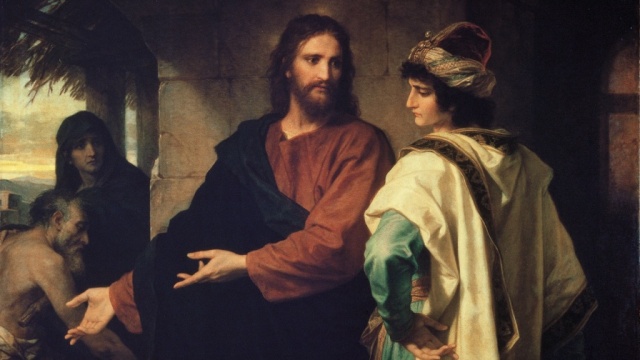
As Jesus was setting out on a journey, a man ran up, knelt down before him, and asked him, "Good teacher, what must I do to inherit eternal life?" Jesus answered him, "Why do you call me good? No one is good but God alone. You know the commandments: You shall not kill; you shall not commit adultery; you shall not steal; you shall not bear false witness; you shall not defraud; honor your father and your mother."He replied and said to him, "Teacher, all of these I have observed from my youth."  Jesus, looking at him, loved him and said to him, "You are lacking in one thing. Go, sell what you have, and give to the poor and you will have treasure in heaven; then come, follow me." At that statement his face fell, and he went away sad, for he had many possessions. Jesus looked around and said to his disciples, "How hard it is for those who have wealth to enter the kingdom of God!" The disciples were amazed at his words.  So Jesus again said to them in reply, "Children, how hard it is to enter the kingdom of God! It is easier for a camel to pass through the eye of a needle than for one who is rich to enter the kingdom of God." They were exceedingly astonished and said among themselves, "Then who can be saved?" Jesus looked at them and said, "For human beings it is impossible, but not for God. All things are possible for God." Peter began to say to him, "We have given up everything and followed you." Jesus said, "Amen, I say to you, there is no one who has given up house or brothers or sisters or mother or father or children or lands for my sake and for the sake of the gospel who will not receive a hundred times more now in this present age: houses and brothers and sisters and mothers and children and lands, with persecutions, and eternal life in the age to come."  This is the Word of the Lord.

L-Evanġelju
Qari skont San Mark 10, 17-30
F'dak iż-żmien, Ġesu' kien se jaqbad it-triq lejn Ġerusalem, meta mar fuqu wieħed jgħaġġel, niżel għarkupptejh quddiemu u qallu: "Mgħallem tajjeb, x'għandi nagħmel biex nikseb il-ħajja ta' dejjem? Qallu Ġesu':  " Għaliex qiegħed issejjaħli tajjeb'?   Ħadd m'hu tajjeb ħlief Alla biss. Inti l-kmandamenti tafhom:  la toqtolx, la tiżnix, la tisraqx, la tixhedx fil-falz, la tiħux bil-qerq dak li hu ta' ħaddieħor; weġġaħ lil missierek u 'l ommok".U dak wieġbu u qallu:   "Mgħallem, jiena dan kollu  ili nħarsu minn żgħożiti."  Imbagħad Ġesu' xeħet fuqu ħarsa ta' mħabba u qallu:  "Ħaġa waħda tonqsok: mur  bigħ li għandek, agħtih lill-fqar, u  jkollok teżor fis-sema; imbagħad ejja u imxi warajja."   Imma għal dan il-kliem ir-raġel qarras wiċċu u telaq b'qalbu sewda, għaliex kellu bosta ġid.Ġesu' mbagħad ħares ħarsa madwaru u qal lid-dixxipli tiegħu:  "Kemm hi iebsa għall-għonja li jidħlu fis-Saltna ta' Alla!" Id-dixxipli stagħġbu għal din il-kelma, imma Ġesu' reġa' qalilhom:  "Kemm hi iebsa, uliedi, li wieħed jidħol fis-Saltna ta' Alla!  Eħfef li ġemel igħaddi minn għajn ta' labra milli wieħed għani jidħol fis-Saltna ta' Alla."  Huma stagħġbu wisq aktar, u bdew igħidu wieħed lil ieħor:  "Mela min jista' jsalva?"   Ġesu' ħares lejhom u qalilhom:  "Għall-bnedmin dan ma jistax ikun, imma għal Alla iva;  għax għal Alla kollox jista' jkun." Qabeż Pietru u qallu: "Tajjeb! Aħna ħallejna kollox, u ġejna warajk." Qallu Ġesu':  "Tassew ngħidilkom, li fost dawk kollha li minħabba  fija u l-Evanġelju jħallu lil darhom jew lil ħuthom jew lil ommhom jew lil missierhom jew lil uliedhom jew l-egħlieqi tagħhom, ma hemm ħadd  fosthom li minn issa, f'din id-dinja stess, ma jirċevix, għal mitt darba iktar, djar,  aħwa, subien u bniet, ommijiet, ulied u għelieqi flimkien ma' persekuzzjonijiet, u l-ħajja ta' dejjem fiż-żmien li ġej." Il-Kelma tal-Mulej

//////////////////////////   


How to Inherit Eternal Life

A reflection by Fr. Thomas Rosica, CSB

Mark's Gospel story of Jesus' encounter with the man seeking eternal life is essentially a vocation story (Mark 10:17-30). It is the only story in Mark in which the individual called responds not by following but by going away.

The story is narrated in all three Synoptic Gospel accounts. Matthew (19:16-22) tells us that the man was young; only Luke (18:18-23) tells us he was ruler. The three evangelists agree that the man was rich, and in Mark, this is the only description given. The rich man's concern is to "inherit eternal life."

Let us consider several aspects of Mark's account of the Gospel episode. First of all, Jesus repudiates the term "good" for himself and directs it to God, the source of all goodness, who alone can grant the gift of eternal life.

Is Jesus' directive to this man with many possessions a requirement for all who wish to inherit eternal life? Is it true that Jesus did not ask other disciples to sell their possessions (1 Tim 6:17-19)? Wasn't Peter able to keep his house and boat for a short period of time (Mark 1:29; John 21:3)? Didn't the women of Galilee continue to have access to their personal, material resources (Mark 15:41), just as Joseph of Arimathea did (15:43)?

It seems that in the case of this man with many possessions in Mark's story, Jesus issued a very personal invitation for very specific reasons. Why does this young man find the teaching of Jesus so difficult to accept? In the Old Testament, wealth and material goods are considered a sign of God's favor (Job 1:10; Psalm 128:1-2; Isaiah 3:10).

Religious Jews believed that wealth was a sign of God's blessing. Rich people were regarded as those God had blessed, and poor people were regarded as those God had cursed.

Power of possessions

The words of Jesus in Mark 10:23-25 provoke astonishment among the disciples because of their apparent contradiction with the Old Testament concept (Mark 10:24.26). Since wealth, power, and merit generate false security, Jesus rejects them utterly as a claim to enter the kingdom. The negative outcome of the man's choice to walk away strikes a note of realism.

It also attests the special power of possessions to hinder Christian discipleship. Jesus uses the rich man's departure as a teaching moment to instruct his disciples about the dangerous snare that earthly possessions, success, and prosperity can have. Total detachment from one's possessions is required of every authentic disciple. Jesus saw the danger of material possessions. They can fix our heart to the world and make us think of everything in terms of price rather than value.

Jesus was trying to completely overturn what the apostles and all other good Jews had been taught. But his teaching on wealth and richness was incomprehensible to the listeners. When Jesus said, "How hard it would be for rich people to enter the Kingdom of God," the Gospel says, "They, the disciples, were exceedingly astonished, and said to him, 'Then who can be saved?'" (v.26).

Any one of us would naturally ask the same question! Jesus reminded them that salvation is purely a gift from God. Grace is God's gift, and only those whose arms and hands are empty of self can stretch out to receive the gift of grace. The achievement of salvation is beyond human capability and depends solely on the goodness of God, who offers it as a gift (Mark 10:27).

A Christian contradiction

In many societies, wealth is a sign of God's approval, and poverty and hardship are the signs of God's disapproval. Every Christian is challenged by the teaching of Jesus and the values of the society which upholds the principle that worth really does come from material wealth: for example, from the number of cars we own, the size of our homes, the amount in our investment portfolios.

When capitalist systems are solely market-driven, heartless, and materialistic, they contradict the Gospel teachings of Jesus. The Gospel of Jesus challenges the "prosperity gospel mentality." Jesus is not speaking against material wealth but condemns being enslaved to and enchained by wealth. It becomes a blessing when it is shared with others, and it becomes an obstacle and a prison for those who do not have the wisdom to share it with others.

As Jesus looked at the rich young man, he looks at each one of us with love. He is reminding us to do "one thing more." We have to allow his loving gaze to penetrate us to the core, and unlike the young man we must open ourselves to transform our lives, upset our values, and rearrange our priorities.

When, considering his language too demanding, many of his disciples left him, Jesus asked the few who had remained: "Will you also go away?"

Peter answered him: "Lord to whom shall we go? You have the words of eternal life" (John 6:67-68).
And they chose to remain with him. They stayed because the Master had "the words of eternal life," words that promised eternity and also gave full meaning to life here and now.

Wisdom and happiness

King Solomon, as seen in the first reading (Wisdom 7:7-11), realized that only true wisdom could bring happiness. He prayed for it and it alone, rather than power, riches, health, or good looks. God gave him everything.

For us, wisdom has become a person, and his name is Jesus. Wisdom was born in a manger and died on a cross and in between said that our only shot at ever being filled up is if we follow him in the life of self-emptying love.

Looking at Jesus, we see what it means to be poor in spirit, gentle, and merciful, to mourn, to care for what is right, to be pure in heart, to make peace, to be persecuted. This is why he has the right to say to each of us, "Come, follow me!"

He does not say simply, "Do what I say." He says, "Come, follow me!"

In the end, Jesus looks intently and lovingly at each one of us and reminds us that life is to be had in its fullness not by accumulating things, honours, privileges, reputations, and prestige but by letting go of things.

Initially, his invitation might surprise, upset, shock, and grieve us. With God's grace, may we realize that Jesus' word is living and effective, sharper than any two-edged sword, penetrating even between soul and spirit, joints and marrow and able to discern reflections and thoughts of the heart (Hebrews 4:12-13). Hopefully, we will not go away sad.

Ordinary life

Following Sunday's Gospel, I encourage you to consider three important teachings of our Catholic tradition, from The Catechism of the Catholic Church and Benedict XVI's encyclical, Caritas in Veritate.

1) The Catechism of the Catholic Church teaches (2404-2405) that our material goods are entrusted to us by God not for our own personal advantage but for the privilege of using them for the good of others. "The ownership of any property makes its holder a steward of Providence, with the task of making it fruitful and communicating its benefits to others, first of all his family. Goods of production - material or immaterial - such as land, factories, practical or artistic skills, oblige their possessors to employ them in ways that will benefit the greatest number. Those who hold goods for use and consumption should use them with moderation, reserving the better part for guests, for the sick and the poor."

2) "The second truth is that ... authentic human development concerns the whole of the person in every single dimension. Without the perspective of eternal life, human progress in this world is denied breathing space. Enclosed within history, it runs the risk of being reduced to the mere accumulation of wealth; humanity thus loses the courage to be at the service of higher goods, at the service of the great and disinterested initiatives called forth by universal charity.
"Man does not develop through his own powers, nor can development simply be handed to him. In the course of history, it was often maintained that the creation of institutions was sufficient to guarantee the fulfillment of humanity's right to development" (No. 11, Caritas in Veritate).

3) "While the poor of the world continue knocking on the doors of the rich, the world of affluence runs the risk of no longer hearing those knocks, on account of a conscience that can no longer distinguish what is human. God reveals man to himself; reason and faith work hand in hand to demonstrate to us what is good, provided we want to see it; the natural law, in which creative Reason shines forth, reveals our greatness, but also our wretchedness insofar as we fail to recognize the call to moral truth" (No. 75, Caritas in Veritate).
///////////////////////////////

Friday, 5 October 2018

Marriage and the Family

October 7, 2012

 Twenty-seventh Sunday in Ordinary Time


Is-27 Ħadd matul is-Sena


Reading 1                       
Genesis 2:18-24
The LORD God said: "It is not good for the man to be alone. I will make a suitable partner for him." So the LORD God formed out of the ground various wild animals and various birds of the air, and he brought them to the man to see what he would call them; whatever the man called each of them would be its name. The man gave names to all the cattle, all the birds of the air, and all wild animals; but none proved to be the suitable partner for the man. So the LORD God cast a deep sleep on the man, and while he was asleep, he took out one of his ribs and closed up its place with flesh. The LORD God then built up into a woman the rib that he had taken from the man. When he brought her to the man, the man said: "This one, at last, is bone of my bones and flesh of my flesh; this one shall be called 'woman, ' for out of 'her man' this one has been taken." That is why a man leaves his father and mother and clings to his wife, and the two of them become one flesh.

L-Ewwel Qari
Qari mill-Ktieb tal-Ġenesi 2, 18-24
Il-Mulej Alla qal:   "Mhux sewwa li bniedem jiqa' waħdu. Ħa nagħmillu għajnuna tgħodd għalih." U l-Mulej Alla sawwar mill-art l-annimali selvaġġi u t-tajt kollu tal-ajru, u ġiebhom quddiem  il-bniedem biex jara xi jsemmihom, u skont ma jkun il-bniedem semma lil kull ħliqa ħajja, dak ikun isimha. U l-bniedem ta isem  lil kull bhima u 'l kull tajra tal-ajru,  u 'l kull annimal selvaġġ;  imma għall-bniedem ma nstabet ebda  għajnuna tgħodd għalih. U l-Mulej Alla tefa' nagħsa tqila fuq il-bniedem;u dan raqad. U ħadlu waħda minn kustiljih  u flokha mlieh bil-laħam.  U l-Mulej Alla sawwar il-kustilja,  li kien ħa mill-bniedem,  f'mara, u ġiiebha lill-bniedem. Imbagħad il-bniedem qal:  "Din id-darba  din hi  għadma  minn għadmi, u  laħam minn laħmi, għalhekk tissejjah mara, għax mir-raġel ittieħdet hi." Għalhekk ir-raġel iħalli lil missieru u lil ommu u jingħaqad ma' martu  u jsiru ġisem wieħed. Il-Kelma tal-Mulej

Responsorial Psalm             
PSALM 128:1-2, 3, 4-5, 6
R. (cf. 5) May the Lord bless us all the days of our lives.

Blessed are you who fear the LORD,
who walk in his ways!
For you shall eat the fruit of your handiwork;
blessed shall you be, and favored.                             R/

Your wife shall be like a fruitful vine
in the recesses of your home;
your children like olive plants
around your table.                                                       R/

Behold, thus is the man blessed
who fears the LORD.
The LORD bless you from Zion:
may you see the prosperity of Jerusalem
all the days of your life.                                                           R/

May you see your children's children.
Peace be upon Israel!                                                 R/

Salm Responsorjali          
Salm 127(128)
R/   `Iberikina l-Mulej, il-jien kollha ta’ hajjitna.

Ħieni kull min jibża' mill-Mulej,
kull min jimxi fit-triqat tiegħu!
Mix-xogħol ta' idejk inti tiekol,
ħieni int, u riżqek tajjeb.                                   R/

Martek tkun bħal dielja għammiela
Fl-irkejjen ta' darek;
uliedek bħal xitel taż-żebbuġ
madwar il-mejda tiegħek.                    R/

Ara, kif ikun imbierek
il-bniedem li jibża mill-Mulej!
Ibierkek il-Mulej minn Sijon!                 R/

Jalla tara l-ġid ta' Ġerusalemm
tul ħajtek  kollha!                    
Jalla  tara wlied uliedek!
Sliem għal Iżrael!                                R/

Reading 2 
Hebrews 2:9-11
Brothers and sisters: He "for a little while" was made "lower than the angels, " that by the grace of God he might taste death for everyone. For it was fitting that he, for whom and through whom all things exist, in bringing many children to glory, should make the leader to their salvation perfect through suffering. He who consecrates and those who are being consecrated all have one origin. Therefore, he is not ashamed to call them 'brothers.'

It-Tieni Qari                                                                                                             
Qari mill-Ittra lil Lhud 2, 9-11
Ħuti, lil dak li għal ftit taż-żmien, kien imniżżel ftit inqas mill-anġli, lil Ġesu', aħna issa qegħdin narawh imżejjen fil-glorja u l-ġieħ minħabba fil-mewt li hu bata, biex, għall-grazzja ta' Alla, il-mewt li daq tkun  għall-ġid ta' kulħadd. Għax kien jixraq li Alla, li għalih u bih sar kollox, waqt li jwassal ħafna wlied għallll-glorja, jagħmel li l-Awtur tas-salvazzjoni tagħhom ikun perfett  bis-saħħa tas-sofferenzi. Għax kemm dak li jqaddes, u kemm dawk li jiġu mqaddsin, ilkoll huma mill-istess wieħed. U għalhekk Ġesu' ma jistħix isejħilhom ħutu. Il-Kelma tal-Mulej.

Gospel        
Mark 10:2-16
The Pharisees approached Jesus and asked, "Is it lawful for a husband to divorce his wife?" They were testing him. He said to them in reply, " What did Moses command you?" They replied, "Moses permitted a husband to write a bill of divorce  and dismiss her." But Jesus told them,"Because of the hardness of your hearts he wrote you this commandment. But from the beginning of creation, God made them male and female.For this reason a man shall leave his father and mother and be joined to his wife, and the two shall become one flesh. So they are no longer two but one flesh. Therefore what God has joined together, no human being must separate." In the house the disciples again questioned Jesus about this. He said to them, "Whoever divorces his wife and marries another commits adultery against her; and if she divorces her husband and marries another, she commits adultery." And people were bringing children to him that he might touch them, but the disciples rebuked them. When Jesus saw this he became indignant and said to them, "Let the children come to me; do not prevent them, for the kingdom of God belongs to such as these.Amen, I say to you, whoever does not accept the kingdom of God like a child will not enter it." Then he embraced them and blessed them, placing his hands on them.

Evanġelju
Qari skond San Mark 10, 2-16
 F'dak iż-żmien, resqu xi Fariżej lejn Ġesu' u biex iġarrbuh staqsewh jekk raġel jistax jitlaq 'il martu. Weġibhom u qal:  "X'ordnalkom Mose?" Qalulu:  "Mose' ta  l-permess li wieħed jagħmel il-kitba tad-divorzju, u jibgħatha." Imbagħad weġibhom Ġesu':  "Minħabba l-ebusija ta' qalbkom kitbilkom din l-ordni.  Iżda sa mill-bidu  tal-ħolqien Alla għamilhom raġel u mara. Għalhekk mela raġel jħalli lil missieru u 'l-ommu u jingħaqad ma' martu, u t-tnejn isiru ġisem wieħed.Għalhekk  mhumiex iżjed tnejn, imma ġisem wieħed. Mela dak li għaqqad Alla ma għandux jifirdu l-bniedem." Xħin daħlu d-dar id-dixxipli reġgħu staqsewh fuq dan, u hu qalilhom:  "Min jitlaq lil martu u jiżżewweġ oħra jkun ħati ta' adulterju kontra l-ewwel waħda; u jekk mara titlaq lil żewġha u tiżżewweġ ieħor tkun ħatja ta' adulterju." Ġibdulu quddiemu  xi tfal ċkejknin biex iberrikom, iżda d-dixxipli tiegħu qabdu jgħajtu magħhom. Ġesu', meta ra hekk, inkorla u qalilhom: "Ħalluhom it-tfal iż-żgħar jiġu għandi; iżżommuhomx, għax ta' min hu bħalhom hija s-Saltna ta' Alla.   Tassew  ngħidilkom, li min
is-Saltna ta' Alla ma  jilqgħhiex bħal tifel ċkejken ma jidħolx fiha."   Imbagħad ħaddanhom
miegħu u qiegħed idejh fuqhom u berikom.    Il-Kelma tal-Mulej.

////////////
Marriage and the Family: Humanity's Future

A reflection by Fr. Thomas Rosica, CSB


Rather than commenting in detail on each of the readings for the 27th Sunday in Ordinary Time (B), I would like to offer some general reflections on marriage and family life that flow from Sunday’s readings. In today’s Gospel (Mark 10:2-16) the Pharisees once again confront Jesus with the divisive issue of divorce and its legitimacy: “Is it lawful for a husband to divorce his wife?”

“What did Moses command you?” Jesus asked. They replied that Moses permitted a husband to write a bill of divorce and dismiss the wife. Jesus declares that the law of Moses permitted divorce (Deuteronomy 24:1) only because of the hardness of hearts (Mark 10:4-5). In citing Genesis 1:27 and 2:24, Jesus proclaims permanence to be the divine intent from the beginning concerning human marriage (Mark 10:6-8). He reaffirms this with the declaration that what God has joined together, no human being must separate (verse 9).
Jesus wisely and prudently responds to the loaded question by appealing to God’s plan of complete unity and equality in drawing men and women together in marriage. He affirms that husband and wife are united so intimately that they actually become one and indivisible. In answering a direct question that was deliberately designed to entrap him, Jesus was speaking of the nature of marriage and of that only. His emphasis is on its holiness and covenant fidelity and not on the illegitimacy of divorce. The goal of marriage is not divorce and annulment!

Divorce, annulment and remarriage

Jesus did not condemn people who did their best and ended up divorced. He was not judging such people, throwing them out of the community of the Church, or assigning them places in hell. He was only affirming the outlook taken by couples themselves when they stand before the Church’s minister and pronounce their wedding vows.

Today Catholic annulments look to many like a simple Catholic divorce. Divorce says that the reality of marriage was there in the beginning and that now the reality is broken. Annulment is a declaration that the reality was never there. The Church declares many marriages invalid because of some impediment present at the time of the marriage. 
Over the years of my pastoral ministry, I have met many divorced people who feel very alienated from the Church. For many, divorce was the last thing they ever dreamed of or wanted. In many instances, it hit them unexpectedly, forcefully and tragically. No one I met ever told me that they looked forward to a divorce. They simply didn’t see any other alternative. 

Some divorced men and women have erroneously been told by well-meaning people that they are excommunicated from the Catholic Church, which is certainly not true. Their pain is often enormous; their need for understanding and acceptance is great. They need unambiguous Catholic teaching to enlighten them and lead them to Christ. They need friends, people to pray for and with them, and they need God in their lives in the midst of rupture and brokenness. They deserve our understanding and our prayerful care.

A positive teaching on annulments should be offered in every parish community. Though it may be a tedious and painful process for some people, an annulment can be an instrument of grace, healing, closure, and peace of mind and heart.

The future of humanity passes through marriage and the family

In the papal encyclicals from "Humanae Vitae" (1968) to "Evangelium Vitae" (1995) and especially the apostolic exhortation "Familiaris Consortio" (1981) and the magnificent "Letter to Families" (1994), Popes Paul VI and John Paul II have dedicated much attention to marriage and the family in today’s culture. From the first year of his pontificate, John Paul II constantly emphasized: “the family is the way of the Church." The family is a school of communion, based on the values of the Gospel. 

In 2008, on the occasion of the 40th anniversary of the encyclical "Humanae Vitae," the bishops of Canada released a very important document in which they wrote (#19):

“In short, Pope Paul Vl’s encyclical 'Humanae Vitae' and the subsequent 'theology of the body' developed by Pope John Paul II issue an immense challenge to a world that is too often occupied with protecting itself against the extraordinary life potential of sexuality. In the wake of these two prophetic Popes, the Church, 'expert in humanity,' issues an unexpected message: Sexuality is a friend, a gift of God. It is revealed to us by the Trinitarian God who asks us to reveal it in turn in all its grandeur and dignity to our contemporaries at this start of the third millennium. The theology of the body has been compared to a revolution that would have positive effects throughout the 21st century of Christianity. We invite the faithful to be the first to experience its liberating potential.”

Signs of hope for marriage, family life and vocations

To accept Jesus’ teaching on marriage requires the openness of children and a sense of dependence on God’s strength matching the child’s sense of dependence on parents. When love is authentic, strong, sincere and firm, it is accompanied by vision, joy and creativity, new life and a desire for holiness. When married couples allow Christ to be at the center of their project, they experience deeply the peace outpoured by God -- a peace that flows forth to their children and grandchildren.

The crisis of vocations in the Western world requires that we rethink not only our manner of promoting vocations, but the terrain where seeds of vocations are sown. This fertile soil for vocations is the family, the domestic Church. This reality is brought about by the presence of Christ in the home, from the graces of the sacraments, especially the Eucharist, and from fidelity to the Gospel and the teachings of the Church.

There are some voices in our society and Church that don’t have much hope for the sacrament of marriage and for family life. I beg to differ with such voices of doom and despair. Each of us is responsible for fostering a true culture of marriage and family life as well as a culture of vocations to the priesthood and religious or consecrated life.

Over the past year in particular, I have witnessed some very hopeful signs for marriage and family life among young adults in various parts of the world. I had the privilege of leading two retreats for university students -- one for the John Paul II Catholic Chaplaincy of Sheffield’s Hallam University in England and the other for the Catholic Students’ Association of Victoria University in British Colombia in Canada. 

The wise, ecclesial leadership of university chaplains -- Sister Anne Lee, NDS in Hallam and Father Dean Henderson in Victoria -- gathered together some remarkable young adults from many countries of the world. They are the young men and women of the generations of John Paul II and Benedict XVI, freed from the ideological strangleholds and liberated from the barren, spiritual wastelands of my generation. Their eyes are fixed on Christ and they love the Church with all of her shadows and light.

I never had more open conversations about marriage and family life than I did with those students in Hallam and Victoria these past months. Many spoke openly about their parents who were divorced and alienated or simply absent from the Church. The students said that they learned from the mistakes and losses of their parents, and wanted to pursue the path of a holy marriage and family life. They desire to have Christ, the sacramental life, and the teachings of the Church at the center of their lives.

I have also been very moved and edified by the young men and women who form the staff of the Salt and Light Television Network in Canada. Their simple and clear faith, deep joy, sterling commitment, visible love of Christ and the Church and ardent desire for evangelization is inspiring. Over the past six years, I have been privileged to witness the religious professions and ordinations of several Salt and Light colleagues, and to celebrate seven marriages of my staff -- several who worked with me in preparing World Youth Day 2002. And now we are into the season of baptisms! It is from this generation of children that will come forth vocations for the Church. How could there not be vocations when the terrain was so fertile and the parents so open to the Gospel and to the Church?


////////////////////////////////////

Friday, 28 September 2018

The Lord speaks...


Twenty-sixth Sunday in Ordinary Time

Is-26 Ħadd matul is-Sena
Messalin B p 475

Reading 1                      
Numbers 11:25-29
The LORD came down in the cloud and spoke to Moses. Taking some of the spirit that was on Moses, the LORD bestowed it on the seventy elders; and as the spirit came to rest on them, they prophesied. Now two men, one named Eldad and the other Medad, were not in the gathering but had been left in the camp. They too had been on the list, but had not gone out to the tent; yet the spirit came to rest on them also, and they prophesied in the camp. So, when a young man quickly told Moses, "Eldad and Medad are prophesying in the camp, " Joshua, son of Nun, who from his youth had been Moses?aide, said, "Moses, my lord, stop them." But Moses answered him, "Are you jealous for my sake? Would that all the people of the LORD were prophets! Would that the LORD might bestow his spirit on them all!" This is the Word of the Lord.

L-Ewwel Qari
Qari mill-Ktieb tan-Numri 11, 25-29
F'dak iż-żmien,  Il-Mulej niżel fi sħaba jkellem 'il Mose', u ħa mill-ispirtu li kellu fih, u tah lis-sebgħin xiħ; u ġara li, hekk kif l-ispirtu qagħad fuqhom, bdew jipprofetizzaw, imma ma ssoktawx.Issa fil-kamp kien baqa' żewġt irġiel, wieħed jismu Eldad u l-ieħor Medad,  u fuqhom ukoll niżel l-ipirtu. Hekk dawn ġew magħduda mal-magħżulin għax, għalkemm  ma marrux fit-Tinda,  bdew jipprofetizzaw fil-kamp. Dlonk mar wieħed żagħżugħ jgħarraf b'dan il-Mose' u qallu: "Eldad u Medad qegħdin jipprofetizzaw fil-kamp." U Ġożwe' bin Nun, li minn ċkunitu kien qaddej ta' Mose', qabad u qal:  "Sidi Mose', tħallihomx aktar."Iżda' Mose' wieġbu:  "Jaqaw qiegħed tgħir minħabba fija? Jalla l-poplu tal-Mulej ikun kollu profeti, u jalla l-Mulej iqiegħed fuqhom l-ispirtu tiegħu." Il-Kelma tal-Mulej 
              
Responsorial Psalm             
PSALM 19:8, 10, 12-13, 14
R. (9a) The precepts of the Lord give joy to the heart.

The law of the LORD is perfect,
refreshing the soul;
the decree of the LORD is trustworthy,
giving wisdom to the simple.                          R/

The fear of the LORD is pure,
enduring forever;
the ordinances of the LORD are true,
all of them just.                                                R/

Though your servant is careful of them,
very diligent in keeping them,
Yet who can detect failings?
Cleanse me from my unknown faults!           R/

From wanton sin especially, restrain your servant;
let it not rule over me.
Then shall I be blameless and innocent
of serious sin.                                                 R/

Salm Responsorjali
(Salm 18 (19)
      R/  Il-preċetti tal-Mulej dritti, u jiferrħu l-qalb.
Il-liġi tal-Mulej perfetta,
u tagħti l-ħajja;
ix-xhieda tal-Mulej hi sewwa,
u tgħallem lil min ma jafx.                   R/

Il-biża' tal-Mulej sinċier,
u jibqa' għal dejjem;
il-ġudizzji tal-Mulej sewwa,
u mseddqa għalkollox.                        R/

Fehemhom sewwa l-qaddej tiegħek;
ħlas tajjeb għandu min iħarishom.
In-nuqqas  min jista'  jagħrfu?
Minn dak li ma nafx bih saffini.            R/

Mill-kburija wkoll ħares il-qaddej tiegħek,
tħalliha qatt  taħkimni.
Imbagħad inkun bla ħtija
u ħieles minn dnub kbir.                      R/       

Reading 2           
James 5:1-6
Come now, you rich, weep and wail over  your impending miseries. Your wealth has rotted away, your clothes  have become moth-eaten, your gold and silver have corroded, and that corrosion will be a testimony against you; it will devour your flesh like a fire. You have stored up treasure for the last days. Behold, the wages you withheld from the workers who harvested your fields are crying aloud; and the cries of the harvesters have reached the ears of the Lord of hosts. You have lived on earth in luxury and pleasure; you have fattened your hearts for the day of  slaughter. You have condemned; you have murdered the righteous one; he offers

It-Tieni Qari
Qari mill-Ittra ta' San Ġakbu 5, 1-6
Ejjew issa, intom il-għonja, ibku u ixhru fuq l-għawġ li ġej fuqkom! Ġidkom  tħassar, ħwejjiġkom kilithom il-kamla.  Id-deheb u l-fidda tagħkom rabbew is-sadid, u s-sadid tagħkom  għad jixhed  kontra tagħkom u jiklilkom ġisimkom bħal nar. Ħżintu  l-ġid fl-aħħar jiem! Ara, il-ħlas tal-ħaddiema li ħasdu l-għelieqi tagħkom –  ħlas li  intom żammejtuhulhom   bil-qerq –qiegħed jgħajjat kontra  tagħkom, u l-biki  ta' dawk li ħasdu wasal f'widnejn il-Mulej tal-eżerċti. Fuq l-art għextu fix-xalar u l-lussu;qgħadtu tissemmnu għall-jum tal-qatla. Intom  ikkundannajtu l-ġust,  qtitluh għax ma jistax jiqfilkom! Il-Kelma tal-Mulej
you no resistance.  This is the Word of the Lord.

Gospel                
Mark 9:38-43, 45, 47-48
At that time, John said to Jesus, "Teacher, we saw someone driving out  demons in your name, and we tried to prevent him because  he does not follow us." Jesus replied, "Do not prevent him. There is no one who performs a  mighty deed in my name who can at the same time speak ill of me. For whoever is not against us is for us. Anyone who gives you a cup of water to drink because you belong to Christ, amen, I say to you, will surely not lose his reward. "Whoever causes one of these little ones  who believe in me to sin, it would be better for him if a great millstone were put around his neck and he were thrown into the sea. If your hand causes you to sin, cut it off. It is better for you to enter into life maimed than with two hands to go to  hell, into the unquenchable fire. And if your foot causes you to sin, cut if off. It is better for you to enter into life crippled than with two feet to be thrown into hell. And if your eye causes you to sin, pluck it out. Better for you to enter into the
kingdom of God with one eye than with two eyes to be thrown into hell, where 'their worm does not die, and  the fire is not quenched.'"

L-Evanġelju
Qari skont San Mark.9, 38-43. 45. 47-48
 F'dak iż-żmien,  Ġwanni qal lil Ġesu': "Mgħallem, wieħed raġel,  li soltu ma jkunx magħna, rajnieh ikeċċi x-xjaten f'ismek u ridna  nżommuh, għax hu mhuxiex wieħed minn  tagħna." Imma Ġesu' qal:  "La żżommuhx, le, għax ma hemm ħadd li se  jagħmel miraklu f'ismi u mbagħad malajr se jkollu ħila jgħid  kontra tiegħi.Għax min mhuxiex kontra tagħna, huwa magħna. Min jagħtikom tazza ilma x'tixorbu għax intom tal-Messija,ngħidilkom is-sewwa li ma jibqax mingħajr il-ħlas tiegħu. Imma min jagħti skandlu lil wieħed minn dawn iċ-ċkejknin li jemmnu fija, ikun jaqbillu jekk jorbtulu ma' għonqu ġebla  tat-tħin minn dawk li jdawru l-ħmir u jixħtuj fil-baħar.  U jekk  idek hija għalik okkażjoni ta' dnub, aqtgħha barra; jaħbatlek  aħjar li tidħol b'id waħda, milli tmur  b'idejk it-tnejn fl-infern,  fin-nar li ma jintefiex. U jekk riġlek hu għalik okkażjoni ta' dnub, aqtgħu barra; jaħbatlek aħjar li tidħol b'riġel wieħed fil-ħajja milli  tinxteħet  b'riġlejk it-tnejn fl-infern.   U jekk għajnek hi għalik okkażjoni ta' dnub, aqlagħħa barra; jaħbatlek aħjar li tidħol b'għajn  waħda fis-Saltna ta' Alla milli tinxteħet b'għajnejk it-tnjen fl-infern, fejn id-dud tagħhom ma jmutx u fejn in-nar ma jintefiex." Il-Kelma tal-Mulej.     


A reflection by Fr. Thomas Rosica, CSB 

The severe denunciation of the unjust rich in Sunday's second reading from the Letter of James (5:1-6) is reminiscent of the Old Testament prophets (e.g., Amos 8:4-8). It is not intended to influence the rich to whom it is rhetorically addressed, but is rather a salutary warning to the faithful of the terrible fate of those who abuse riches and perhaps also a consolation to those now oppressed by the rich (James 2:5-7). The identical mode of introduction in 5:1-6 and 4:13-17 and the use of direct address throughout indicate the parallelism of the two sections. However, the present passage is harsher in tone and does not seem to allow the chance for repentance. In 5:2-3, the perfect tense of the verbs used (rotted, moth-eaten, rusted) probably indicate the present worthlessness of wealth. Furthermore, although silver and gold do not actually rust (verse 3), the expression used for them indicates their basic worthlessness.

This reading from James does not parallel the other two readings, especially in the matter of spiritual gifts manifesting themselves outside the immediate circle of Jesus' disciples. Nevertheless it offers hard words against the wealthy who abused their workers and withheld wages and insight into abuse of power. James is speaking explicitly of the secular realm of employment, salaries and just recompense for work. The author of James maintains that the rich have mistreated their employees. Since they withheld the wages that were due, their silver and gold will corrode and their garments will fall prey to ravaging moths. The wealthy have not realized that God is the God of the poor, and intercedes on their behalf.

Problems in Mark's Church community

Today's Gospel passage (Mark 9:38-43, 45, 47-48) is rather loosely put together and seems to reflect the problems of Mark's Church community. First there is the exchange between John and Jesus about the foreign exorcist (9:38), followed by Jesus' rejection of the elitism of the disciples (verses 39-40). In the second part (verse 41), anyone who gives the disciple a drink will belong to Christ; in the third part (verse 42), Jesus holds up the little ones as totally dependent on God, whom no one may lead astray.

There is a certain irony about Jesus' explanation of the disciples' action in trying to stop the foreign exorcist. In 9:14-29, the disciples, themselves, fail to exorcise an unclean spirit from a young boy and are sharply rebuked by Jesus. Now they want to restrain a successful exorcist simply because he is not part of their own group. The issue is clearly not whether the exorcist is acting in the name and power of Jesus, but whether he is part of their own chosen establishment. The exclusivist attitudes of the disciples are exposed for all to see. The success of the foreign exorcist is a threat to the status of the "official" disciples! Jesus answers with an inclusive word, and yet one that realistically recognizes the problem of unauthorized ministries (9:39). The disciples need to nurture the gifts of generosity and graciousness.

The need for self-criticism

In the second half of the passage, we find a miscellaneous collection of sayings that call for a stance of self-criticism. The disciples are directed to reflect on their own style of life and ministry. Do any of their words or actions serve as stumbling blocks for the children of the Church? Mark uses words of Jesus against scandal and the misuse of one's hands, eyes and feet. Jesus does not mandate mutilation. He has a typically Semitic way of speaking -- graphic, vivid, even exaggerated. Nothing, no one comes before Christ. Jesus' command to "cut it off" is not mutilation, but rather an invitation to liberation. It liberates us to love without reservation, not trapped in the self-love where everything and perhaps everyone, even God, himself, must revolve around me. The fascinating paradox of this story is this: The more we focus on the God who lives in us, on the people God cherishes in a special way because they are more needy, and on the earth that God saw as being "very good" (Genesis 1:31), the richer will be our delight in ourselves. Human life is a matter of relationships: with God, with people, with earth.

Despite its disjointedness, today's Gospel passage provides a strong antidote to the ever-present temptation to overestimate one's own position as the chosen of God. Human nature tends to be judgmental. Sometimes our inclination to judge results in elitism, concluding that others are not worthy of our company. We make difficulties, not thinking of others but blindly plunging ahead with feet, hands and eyes. We ignore God's consecration of our hands to work, of our eyes to perceive, and of our feet to walk God's special ways. We reject others as outsiders, foreign to our own ranks and status in life. Instead of questioning the validity of other active, and perhaps successful groups, we are reminded in graphic fashion of the importance of self-criticism and humility.

A final thought on humility

Jesus said, "Learn of me, because I am meek, and humble of heart: and you shall find rest to your souls" (Matthew 11:29). Most of the saints prayed for and manifested humility in their lives. Many of us live in societies and cultures that value self-promotion of worth, assertiveness, competitiveness, communicating our accomplishments if we wish to get anywhere and make a difference.

The virtue of humility is a quality by which a person considering his or her own defects has a lowly opinion of himself and willingly submits himself or herself to God and to others for God's sake. How can we strike a balance between being humble and meek, and assertive enough to succeed in the world today? Or do we need to sacrifice one for the other? In living just and upright lives, we can do a good job as a humble leader, but that is different from been able to succeed and being placed in greater positions of responsibility.

//////////////////////////////